Category: Gold Medal Stories

  • COVID-19 in Colombia: A New Trigger for Health Care Disparities

    COVID-19 in Colombia: A New Trigger for Health Care Disparities

    Published on October 28, 2020
    avatar

    Paula Andrea Forero

    Radiology Research Assistant
    Fundación Santa Fe de Bogotá
    avatar

    Ángela Moreno

    Radiologist, Department of Cardiothoracic Imaging
    Fundación Santa Fe de Bogotá
    avatar

    Bibiana Pinzón

    Radiologist, Department of Cardiothoracic Imaging
    Fundación Santa Fe de Bogotá

    In March 2020, Colombia first faced what would become the cause of a new kind of chaos in this country: the coronavirus disease (COVID-19) pandemic. Nobody knew for sure what it was about, but one certainty was that we had to be prepared for the fight. However, it wasn’t as simple as it sounded, especially in a country were the health care system teeters every day on that fine line between sustainability and collapse.

    In an undeveloped region, Colombia experiences barriers to health constantly. Despite having a policy that, ideally, aims to guarantee access and equity, the reality reveals the opposite. In this case, the COVID-19 outbreak tipped the balance further in favor of disparity: across the country, hospital infrastructure and capacities were not sufficient. Medicines—sedatives, anesthetics agents, even oxygen—and supplies, such as ventilators, were also in short supply. In addition, the availability of personal protective equipment (PPE) varied according to the prestige of the institutions; therefore, it was not uncommon to see health care workers in rural areas exposed to the virus without any protective measures. Not to mention that social indiscipline contributed to poor epidemiological control. With the arrival of the COVID-19 vaccine, things didn’t change much. Compared to countries on continents like North America and Europe, Colombia in northern South America has a very low rate of vaccination. Only 16.5% of Colombians are vaccinated. Vaccine prioritization is determined by the government, depending upon age and the availability of boosters, which are scare at times. 

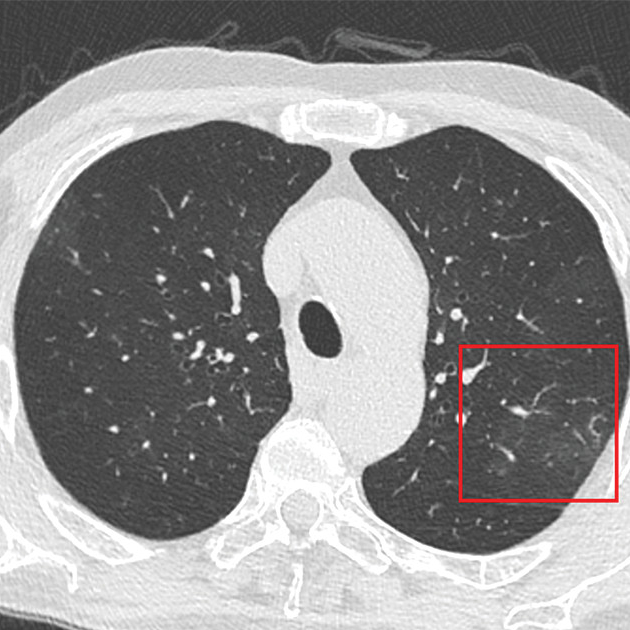
    As our lives changed, so did our work in medicine. Undoubtedly, medical imaging and diagnostic radiologists became even more important resources in this battle. The demand for our specialty increased enormously, bringing new challenges to overcome. Radiologists had to learn a new language—the language of COVID-19—which included new imaging classifications, findings, and approaches (Fig. 1).
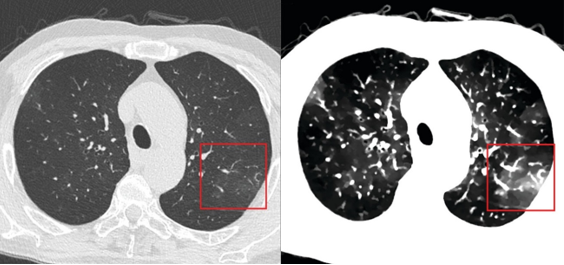
    The radiological diagnosis of a new, lethal entity was in our hands. Regarding personnel, technicians, nurses, and radiologists remain on the front lines, due to their contact with ill or potentially infected patients; and as for statistics, the number of chest radiographs and CT scans increased exponentially throughout this period. They are still our most requested studies.

    However, these numbers have been very fluctuant. At the beginning of the pandemic, in March and April of 2020, when both quarantine and curfew were established, the number of imaging studies related to COVID-19 at our institution in Bogotá were 77 and 160, respectively. Come August, our total COVID-19-related images numbered 1,617, coinciding with the country’s epidemiological peak. This year, January, May, and June have been the months with the most imaging evaluations made (1,953, 2,823, and 3,124, respectively), surpassing what we interpreted in many months of 2020. These data show that as the virus evolved and infection control and prevention became more lax, Colombians forgot about self-care and contagion increased significantly, producing an evident strain on medical staff and the entire health care system.

    This situation is not over yet. Although many advances have been made, there is still a lot of uncertainty—still a long way to go. Hopefully, better days are coming for Colombia and for all of us. COVID-19, beyond doubt, represents a lesson to countries around the world in reassuring the public health care system as a fundamental pillar of society.
  • Better Days Ahead: A Briefing from Brazil’s COVID-19 Outbreak

    Better Days Ahead: A Briefing from Brazil’s COVID-19 Outbreak

    Published May 11, 2021

    avatar

    Rubens Chojniak

    Head of Diagnostic Imaging Department, A. C. Camargo Cancer Center São Paulo, Brazil
    Treasurer, Brazilian College of Radiology (2021–2022)

    avatar

    Valdair Muglia

    Associate Professor, Ribeirao Preto School of Medicine University of São Paulo
    President, Brazilian College of Radiology (2021–2022)

    For valiant service selflessly rendered on the frontlines of the fight against COVID-19, the American Roentgen Ray Society symbolically awarded each and every one of our members the 2021 ARRS Gold Medal. The ARRS Gold Medal Story Series shares perspectives of imaging professionals who conquered the day-to-day challenges of battling COVID-19.

    One of the countries most severely hit by the coronavirus disease (COVID-19) pandemic, cases and deaths are spreading in Brazil.

    The Brazilian health care system, “Sistema Único de Saúde,” is a universal, comprehensive, and free-of-charge public service assisting more than 120 million people. During previous public health emergencies, like the HIV pandemic of the 1990s, the system worked efficiently. Therefore, it was expected our system would place the country in an excellent position to mitigate the COVID-19 pandemic.

    That was not the case.

    Public and private hospitals had been reorganized to treat COVID-19 patients, but the country began to see a rapid uptick in new cases. Each region of the country—a country of continental dimensions—had peaked at different times, and several cities had their health care systems exhausted at different times.  

    The limited number of reverse transcriptase polymerase chain reaction tests available in many centers, and the prolonged time to process their results, have led to the early use of CT as an auxiliary method for screening suspected cases. This use of CT in suspected cases had been described in many countries experiencing similar scenarios and was mentioned in the guidelines of several international radiological societies.

    At our hospital, a public university hospital in São Paulo State with more than 1,000 beds, the scenario was no different. To help cope with the adaptations required to overcome the myriad challenges imposed by this pandemic, a Crisis Committee was created, gathering the major players engaging with COVID-19: medical specialists like radiologists, nursing and physical therapy staff, as well as other professionals providing all kinds of goods and services in a hospital. Since March 2020, our crisis counselors have convened every day (except from September to November), including weekends and holidays. Their daily briefings offer quick, practical solutions to dynamic problems.

    In treating COVID-19-positive patients, our radiological services have experienced a significant increase in chest CTs and a marked reduction in imaging tests performed for other indications. To help limit the spread of infection, many departments had to turn their focus toward fighting COVID-19.

    In September, due to general improvement of the overall situation in Brazil, some health services began returning appointments for care that had been postponed, particularly resuming treatment for chronic diseases and cancer.

    This scenario lasted for a short time, until January 2021, when the pandemic’s second wave hit Brazil even more severely with the more virulent variant, P1, accounting for more than 80% of new cases. At this time, the scene is even more stark, quickly draining the resources of both public and private systems. Even centers that offered adequate assistance in the first wave had their capacities depleted during this second wave. Currently, the major issues are lack of ICU beds dedicated to COVID-19 patients and a shortage of specific medical supplies, such as medications for intubation and sedation. Some parts of the country are experiencing an even worse scenario: limited oxygen supplies, for instance.

    Brazil’s national vaccination program against COVID-19 began in February 2021. The elderly and health professionals remain priorities. Although more than 25 million people have been vaccinated, that is merely 12% of our population.

    We are still facing an overloaded health system and a high number of cases and deaths, but we’re starting to see a significant reduction in the number of new COVID-19 cases. And as the vaccination campaign moves forward, we are hoping for better days soon.

  • True Team Efforts

    True Team Efforts

    Published May 10, 2021

    avatar

    Ali Gholamrezanezhad

    Assistant Professor of Clinical Radiology
    Keck School of Medicine, University of Southern California

    For valiant service selflessly rendered on the frontlines of the fight against COVID-19, the American Roentgen Ray Society symbolically awarded each and every one of our members the 2021 ARRS Gold Medal. The ARRS Gold Medal Story Series shares perspectives of imaging professionals who conquered the day-to-day challenges of battling COVID-19.

    As an emergency radiologist, my research projects have focused on emergency radiology and critical medicine. Through these research initiatives, I have identified aspects of my field that I find most rewarding. Focused on exploring new horizons in critical situations, I have found collaboration to be among the most valuable takeaways for my work. Reason being, it complements my hands-on practice and teaching, allowing me to have both an immediate and long-term impact on patient care, especially during emergency situations, such as trauma cases, burn victims, and urgent situations related to coronavirus disease (COVID-19).

    I am currently leading a multinational research team investigating the clinical and nonclinical features of COVID-19. Being able to have a personal impact in response to this pandemic has been a thrilling feeling for me. To date, our team has produced more than 45 journal articles, with over a dozen additional submissions under consideration. Our areas of focus have included: radiologic presentations of COVID-19, clinical factors predisposing patients to complications of COVID-19 (e.g., ICU admission, intubation, or death), long-term pulmonary consequences of COVID-19, the pandemic’s impact on health care workers and medical students, radiology department preparedness for surge potential, factors influencing differential case-fatality rates worldwide, and the best approach transitioning to the post-COVID-19 era. Over the past several months, my research team’s COVID-19 publications have been cited more than 2,500 times, accumulating more than 300,000 downloads by scientific and medical communities across the world. My colleagues’ work is considered a leading source of clinical information about SARS-CoV-2 infection.

    While I have taken great pride in our ability to produce a significant number of research articles on COVID-19, I also feel that our development of a major repository of COVID-19 imaging in such a short period of time, given the significant limitations of social distancing, is just as notable. One of the core things I have learned about meaningful research during this pandemic has been how to accommodate the critical factor of time sensitivity. Having hosted more than 200 videoconferencing sessions, we demonstrated our ability to plan, organize, and lead a team, showcasing my own project management and multi-tasking skills. I look forward to utilizing this amalgamation seamlessly when approaching oversight of future research projects. Specifically, I intend to apply these cross-departmental collaboration skills to extend my impact ability beyond my given area.

    During the outbreak of COVID-19, my team of researchers and medical students set out to educate the radiology community and broader health care system worldwide how to prepare for unusually high patient volumes, publishing several reference articles in various journals, including the AJR and Journal of the American College of Radiology. These articles were published in early February, when minimal COVID-19 cases had been reported in the United States. Our radiology research group formulated several critical recommendations for radiology departments to approach COVID-19 patients in the safest, most efficient manner. It was clear that if a flood of patients were to inundate even the most well-organized departments, that rush would be near impossible to accommodate. As a result, my team and I developed a mass casualty incident (MCI) plan, which consisted of several steps expressly geared toward viral outbreaks like COVID-19. We came up with a clear roadmap for preparation, resource mobilization, imaging chain, adjusting imaging protocols, and education. Specific to education, this plan included MCI simulation and in-service training. The core benefits to having an MCI plan in place include increased patient and staff safety, as well as a decrease in COVID-19 transmission.

    At the height of the pandemic, we conducted a national survey to evaluate the impact of COVID-19 on imaging practices. More than 800 radiologists across the country participated. According to our findings, a large portion of surveyed radiologists, 61%, rated their COVID-19-related anxiety a 7 or higher on a 1–10 scale. Upon further examination, we found that the higher the number of reported cases in a respondent’s respective state, the higher their reported score. Another key finding was that concern regarding personal health was the strongest connector to a higher anxiety score. Therefore, we determined that additional attention must be given to radiologists working in drastically altered practice environments and in remote settings.