
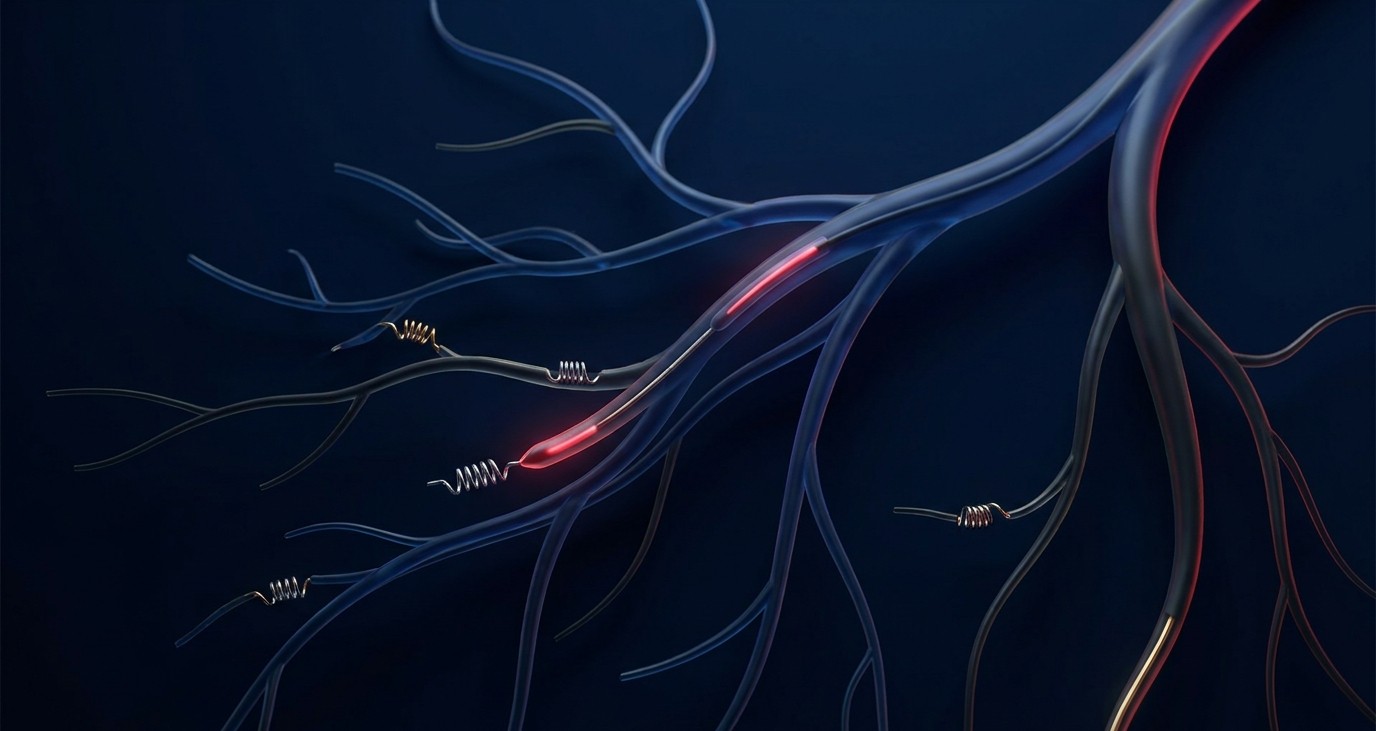
Summary: Fortune favors radial access, 900 µm Embozene for distal branch pruning, and micro-coil embolization positioned above the CCR to safely halt flow below the pubic ramus.
Bloody Brilliant: A strategy targeting the superior rectal artery can effectively manage hemorrhoidal bleeding while avoiding complications. And as Dr. Eric Aaltonen explained during this QuickBytes video, particle sizing and microvascular selection shape procedural success and mucosal safety alike:
- Radial or Femoral? Aaltonen prefers radial access for entering the inferior mesenteric artery to catheterize the superior rectal.
- Next, it’s +/- internal iliac to evaluate MRA.
- Collateral Eval: Assessing internal iliac arteries IDs potential middle rectal collaterals.
- Hybrid-suite cone-beam CT confirms direct branch supply to the CCR or hemorrhoidal plexuses.
- Angio Aim: Target branches exhibit a characteristic tortuous appearance with distal opacification extending to the CCR.
- Mechanics of It All: Microcatheters are advanced distally to prune vascular branches with micro-particles before deploying micro-coils proximal to the CCR.
Unlike onco chemoembolization, hemorrhoids don’t require administering particles all the way to stasis. Micro-particles merely prune the distal vascular bed, after which coils placed above the CCR stop flow below the pubic symphysis.
- 70%: Incidence of self-healing, small ischemic rectal ulcers observed when using 500–700 µm embolic particles.
- 900–1100 µm: Particle size range à la Embozene or Embospheres that eliminates mucosal ulceration entirely.
- Pubic Ramus: Baseline below which all angiographic opacification must cease to achieve procedural stasis.
Leave a Reply