Category: Wellness

  • Talking Your Way Out of Burnout

    Talking Your Way Out of Burnout

    Before the COVID-19 pandemic, physician burnout was its own epidemic with radiologists consistently ranking among the most burned-out medical specialties. The acute and now chronic stressors of the COVID-19 pandemic further exacerbated radiologists’ wellness with 54% of radiologists reporting symptoms of burnout, according to the 2023 Medscape report. In addition to radiologists’ wellness, burnout has significant adverse implications on patient care and outcomes.

    In its most simplistic dissection, burnout is composed of three parts: depersonalization, physical and emotional exhaustion, and low sense of personal accomplishment. As such, the very fundamental aspect of our job as physicians, that of connecting and communicating with patients, may play a central role in physician wellness. A direct association can be observed between physicians’ level of satisfaction with their job and their ability to build rapport and connect with patients. Rapport and relationship building both decrease depersonalization and increase a sense of personal accomplishment. Although anxiety related to challenging physician interactions, which have been shown to last for days beyond the interaction, can lead to fatigue, if cumulative, these interactions may lead to exhaustion. Furthermore, anxiety surrounding challenging patient interactions, like delivering bad news, is more likely to occur if one is faced with such interactions infrequently, and thus feel unprepared or unskilled to navigate them. Demonstrating the critical impact of patient-physician communication interaction on physician mental health, a recent national study of breast radiologists’ wellness found that less time spent connecting with, educating, and consulting patients was statistically significantly associated with greater odds of reporting psychological distress and anxiety. Interestingly, although increase in frequency of more negative and charged patient interactions were reported by some radiologists in the study, no association between negative interactions and mental health was found. It thus appears that it is the length of time allotted for physicians to build rapport and make meaningful connections with their patients to educate and inform, rather than the nature of the interactions themselves, which significantly affects radiologists’ wellness.   

    https://www.radfyi.org/2023/02/15/words-of-wellness-katia-dodelzon/

    As institutions, practices, and individual physicians devise strategies for burnout mitigation, time and adequate focus should be allotted to patient-centered communication.  Operational leadership should be intentional in incorporating sufficient time for radiologists to discuss results and consult with patients into the daily workflow, not limiting interactions in favor of increased volume. Communication skill training should be increasingly integrated into radiology training curricula. In addition, training and effective communication skill resources should be emphasized and made readily available for all faculty to equip radiologists with the confidence to approach a variety of challenging patient interactions, thus diminishing communication-related anxiety. Radiologists themselves should emerge from behind the workstation, seeking out opportunities to consult and educate patients—as our very own wellbeing depends on it.
    <strong>Katerina Dodelzon</strong>, MD, FSBI
    Katerina Dodelzon, MD, FSBI

    Department of Radiology
    Weill Cornell Medicine

    You may also be interested in
  • Words of Wellness: Darcy J. Wolfman

    Words of Wellness: Darcy J. Wolfman

    Wellness at work starts with processes that improve your life, not impede it. Making your job something you look forward to, not dread. The first step is identifying what at work is leading to stress and unhappiness.  

    These can be big things, such as we need more staff to cover calls, or small items, such as moving the cutoff time to read cases from 5:00 to 4:30 pm. The hard part is that these changes are extremely practice-specific. What has helped in my practice is likely to be irrelevant to someone else’s. Therefore, it is critical that leadership listen to radiologists and be willing to make changes. There is no one-size-fits-all, and no one outside your practice can tell you what to do. So, it all starts with identifying pain points, and then getting leadership to listen and be willing to change. 

    <strong>Darcy J. Wolman</strong>, MD
    Darcy J. Wolman, MD

    Johns Hopkins Medicine

    In “Words of Wellness” on www.radfyi.org/, members of the ARRS Wellness Subcommittee share what “wellness” and “wellbeing” mean in their own clinical practices, research focuses, and everyday lives.

    Dr. Wolfman’s ARRS “Sound of Wellness” Playlist Selection:

    Take Me Out to the Ballgame!

    You may also be interested in
  • Words of Wellness: Jay Parikh

    Words of Wellness: Jay Parikh

    I am a breast radiologist and professor of radiology in the division of diagnostic imaging at UT MD Anderson Cancer Center. Most physicians go into medicine and endure medical school and radiology residency for the betterment of patients. Along the course of training and further into our careers, data shows a high prevalence of burnout in radiology. Additionally, physician burnout has been associated with negative outcomes for organizations, physicians, and patients

    Since burnout is a workplace-related phenomenon, radiology practice leaders need to stop redesigning the radiologist. Instead, they should focus on redesigning processes. Physician leadership is inversely related to burnout. Therefore, practice leaders need to be held accountable for radiologist burnout in their workplaces. Radiologists work very hard to become credentialed and take care of patients, so they should not be marginalized into feeling like cogs in a wheel. The road to overcoming the complex issue of radiologist burnout to wellness requires leaders to listen to their radiologists, co-create solutions, and build trust across their teams.

    <strong>Jay Parikh</strong>, MD
    Jay Parikh, MD

    Professor, Department of Breast Imaging,
    Division of Diagnostic Imaging,
    The University of Texas MD Anderson Cancer Center

    In “Words of Wellness” on www.radfyi.org/, members of the ARRS Wellness Subcommittee share what “wellness” and “wellbeing” mean in their own clinical practices, research focuses, and everyday lives.

    Dr. Parikh’s ARRS “Sound of Wellness” Playlist Selection:

    Lean on Me” by Bill Withers

    You may also be interested in
  • How to Add Oil

    How to Add Oil

    In Mandarin Chinese, a phrase that is often said to encourage and support loved ones is 加油 (pronounced jiāyóu). In English, it directly translates to “add oil” or “add fuel.”

    My parents immigrated to the United States from Taiwan in the 1970s and 1980s. My siblings and I were born in Monterey Park, CA, a well-known suburban haven for East Asia Americans. My parents, however, quickly moved us to a predominantly White neighborhood in Orange County, hoping that we would assimilate for a better life. 

    After studying bioengineering in college, I pursued my PhD working on agricultural diagnostics. Early in graduate school, my dad was diagnosed with prior hepatitis B infection and liver cirrhosis. This is when I learned that Asian American men are 60% more likely to die of hepatobiliary cancer, compared to non-Hispanic White men. At the time, I felt ashamed that as a college graduate pursuing an advanced degree, I had been completely ignorant of this health disparity that was pervasive in my own Asian American community. Why did we learn so much about HIV and hepatitis C in school, and so little about hepatitis B? After extended discussions with career mentors and family, I ultimately decided to career-change into medicine; I would apply for and plan to attend medical school after completing my PhD. 

    As a non-traditional applicant, I was fortunate to be accepted into the Medical Innovators Development Program at Vanderbilt University School of Medicine—my dream program, where I could simultaneously learn medicine and keep alive my interest in engineering. As a West Coast native, however, I was not prepared for the culture shock that was waiting for me in the South. Upon transplantation, I was quickly surrounded by microaggressions, which were both confusing and yet oddly familiar. “But where are you really from?” was a common question for me, after offering that I am from Southern California, the place where I was born and spent my childhood.

    Comments about my surprisingly proficient English and catcalls on the street, using deranged pronunciations of East Asian languages from Japanese to Korean, made it clear that strictly based on my appearance, I was not perceived as “American” to my local community. This experience triggered repressed memories of bullying from grade school, when my peers would compare the shape of my eyes to floss and ask me to translate “ching chong ching chong” for them. To which I would respond, confused, that those were not Chinese words, and the words meant nothing. 

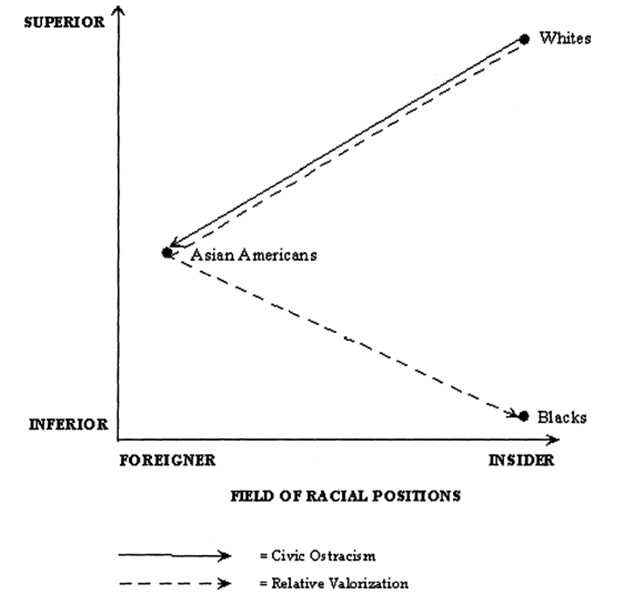
    During medical school, this sparked a new reflection and interest in my experience as an Asian American growing up and living in America. Through the Asian Pacific American Medical Student Association, I participated in an anti-racism workshop in which I learned about the racial triangulation theory (Fig. 1), published by Claire Jean Kim in 1999.

    Fig. 1—’Racial Triangulation’ adapted from Kim, Politics & Society, 1999.

    Kim explains the context of anti-Asian racism, which is based on anti-Blackness. Asian stereotypes such as “oriental” (read: exotic, foreign, anti-Western) and “model minority” (read: quiet, submissive, good-at-math), have been used to drive a wedge between the Asian and Black populations; driving home the message that if Asians would follow the anti-Black social racial hierarchy, they would be passively tolerated—albeit never accepted—in American society. Racial triangulation has since been further extrapolated to additionally include the Hispanic/Latinx experience. From this foundation, I understood that the best way to combat racism is for all populations of color to stand together, with respect and support for one another. 

    Today, I reside again in California. As a diagnostic/interventional radiology trainee, I have started a medical research initiative called Research with Inclusion, Social justice, and Equity or RISE. Our mission is to increase the representation of populations of color in medical research cohorts by supporting data transparency and empowering clinicians and clinical researchers to report the racial/ethnic breakdown of their study cohorts in their demographics table. A question I am often asked is, “how do you find the motivation and energy for it all?” Amid the rampant burnout that plagues our training culture, how do I “add oil” to keep going? My answer is that I reflect on my story, and I remind myself that my story is not unique. I get out of bed in the morning to work toward a hope that one day my story will become a fragment of a past culture in American medicine. And while it’s not a perfect method of fighting burnout, it’s certainly gotten me this far.

    What is your story? How do you add oil?

    <strong>Jessica T. Wen</strong>, MD, PhD
    Jessica T. Wen, MD, PhD

    PGY-3 IR/DR Resident
    Stanford University

    You may also be interested in
  • Can You Learn to Teach?

    Can You Learn to Teach?

    Who is the best lecturer you have ever watched in radiology? Who else comes to mind when you think of amazing educators throughout your radiology career?

    When you think of those individuals, and then think about the teaching you do, do you sort of think to yourself, “gosh, I am not that good, and I could never be that good?”

    Well, I have some good news for you: those amazing lecturers did not start off that way. None of them. I promise. Great teachers, in radiology and other fields, may have some innate talent, but all great lecturers learned through mentors, feedback, and/or trial and error how to get better, to the point of being great. There are too many aspects to becoming an amazing teacher for it all to happen by chance. Some of the great pioneers in radiology education may not have had formal instruction in pedagogy, but at a minimum, they all were probably attuned to incorporating direct and indirect feedback. And they probably had a strong internal process of improving.

    So, how can you get better at teaching, if you really want to be great?

    First, Seek Formal Resources

    Thankfully, there are many well-written resources available throughout the radiology literature. For example, see Heller and Silva’s excellent primer in the Journal of the American College of Radiology (JACR) for delivering a presentation that is informative, notable, and even inspiring .

    One of the best initiatives is ARRS’ own Clinician Educator Development Program (CEDP). Each year, up to 30 ARRS CEDP recipients are selected to receive a travel grant to attend a specialized on-site workshop during the ARRS Annual Meeting. With a curriculum promising increased proficiency in instructional skills, as well as educational activity design, the CEDP remains a highly interactive day of learning. Focusing on new and emerging pedagogical tools, while improving already acquired clinical acumen, over half of this expertly curated syllabus consists of hands-on learning. Offering a unique opportunity to interact with fellow enthusiastic clinician educators, attendees will engage further with the esteemed faculty ARRS has convened—previous CEDP instructors Travis Henry, MD (Duke) and Aaron Kamer, MD (Indiana), as well as Omer Awan, MD (Maryland), Judith Gadde, DO (Northwestern), and myself—on April 15 during the 2023 Annual Meeting in Honolulu, HI.

    Second, Ask for Feedback

    If your lectures are part of a series where evaluations are collected, then ask for them. If there is no feedback available, see if you can collect some. Try sending out your own survey perhaps? If all else fails, you can ask for feedback from one or multiple people you know who happen to be in the audience. One great option for garnering constructive feedback is asking a mentor who is talented at teaching to attend your lecture, then give you some notes. I know it seems like an imposition, but a good mentor will do this for you.

    Optimally, you are seeking honest answers to the following questions:

    • Did you lose your audience? If so, where?
    • What didactic points could have been explained better?
    • What aspects of your lecture were nearly perfect?
    • Are there insights you should keep to use for future talks?

    Third, Construct Internal Feedback

    Observe lectures from an esteemed imaging educator, asking yourself, “how does this lecture differ from mine?” Experiment with employing a similar style—without copying content, of course—and see if it could work for you. One key observation is that many lectures out there aren’t that great, yet it is incredibly easy to copy the predominant style that is used. Copying a mediocre style will make your lecture just as mediocre, so don’t do that. Look to see what the truly great lecturers in radiology are doing.

    To get your improvement process jumpstarted, right off the bat, allow me to share an immediate tip. For JACR, my colleagues and I examined what made a successful lecture, based upon thousands of comments regarding hundreds of lectures given to medical students.

    What was the characteristic most associated with well-received lectures?  

    Interactivity

    Recently noted by AJR, too, the biggest pro tip is interacting with your audience, even if it seems hard or unconventional. You will want to do so in a warm and inviting way, free of condescension. Adding such an interactive element to your teaching will help you forge a stronger connection with all your learners.

    David Naeger, MD
    David Naeger, MD

    Director of Radiology, Denver Health
    Professor and Vice Chair of Radiology

    You may also be interested in
  • Words of Wellness: Jessica Wen

    Words of Wellness: Jessica Wen

    In “Words of Wellness” on www.radfyi.org/, read—and listen!—to members of the ARRS Wellness Subcommittee regarding what “wellness” and “wellbeing” mean in their own clinical practices, research focuses, and everyday lives.

    <strong>Jessica Wen</strong>, MD, PhD
    Jessica Wen, MD, PhD

    Stanford

    “Hello, everyone! My name is Jess Wen, and I am a current PGY-3 IR/DR resident at Stanford. My journey towards wellness has its roots in yoga. My yoga practice started in college, and during graduate school, I became a certified yoga instructor. During medical school, I taught yoga classes for my fellow medical students, weaving concepts of presence and self-awareness into my classes.”

    “As a trainee, I find that training and wellness are often difficult to reconcile; not just for myself, but also for my colleagues. The aspect of wellness that I struggle with the most is self-love. In medicine, we are trained with the expectation to place the hospital’s needs always before our own. Our training culture has classically praised the individual who finds more of themselves to give, without reprieve or compensation. The internalization of this culture manifests as a loss of self-worth. To balance this, I have found that the pillars of self-love can be derived from both the physical principles of yoga—flexibility and strength—in addition to the yogic principle of community.”

    “Flexibility, strength, and community are the mental and social foundations on which I build my self-love and self-acceptance. How do you foster self-love?” 

    Dr. Wen’s ARRS “Sound of Wellness” Playlist Selection:

    Vitamins” by Qveen Herby


    The ARRS Professional and Practice Improvement Committee has been charged with overseeing our professional development programs, cultivating leadership opportunities, as well as initiating several practice quality improvements. Jay Parikh, MD (UT MD Anderson), chairs the new ARRS Wellness Subcommittee: a six-person working group with an overarching charter of promoting both workplace wellness and personal wellbeing to ARRS members of each practice type, private or academic, at every stage of their career, from residency to fellowship to active practice and beyond.  

    https://www.radfyi.org/2023/02/03/the-power-of-connection/embed/#?secret=RtcghZCxLC#?secret=swMTLY4s00
    You may also be interested in

    The opinions expressed on RadTeams are those of the author(s); they do not necessarily reflect the viewpoint or position of the editors, reviewers, or publisher.

  • Words of Wellness: Katia Dodelzon

    Words of Wellness: Katia Dodelzon

    In “Words of Wellness” on www.radfyi.org/, members of the ARRS Wellness Subcommittee share what “wellness” and “wellbeing” mean in their own clinical practices, research focuses, and everyday lives.

    <strong>Katerina "Katia" Dodelzon</strong>, MD, FSBI
    Katerina “Katia” Dodelzon, MD, FSBI

    Weill Cornell

    “I am a breast radiologist and an associate professor of clinical radiology at Weill Cornell Medicine. As an associate program director for diagnostic radiology residency for the last four years, and associate fellowship director for breast imaging, I have worked on various initiatives to augment our trainees’ work-life integration—a crucial factor in training the next generation of physicians.”

    “Building on this work in my recent role as vice chair of clinical operations for our department, I strive to further physician wellness, which has globally taken a hit in recent years. The implications are far-reaching, with direct effect on patient care and health care outcomes.”

    Dr. Dodelzon’s ARRS “Sound of Wellness” Playlist Selections:

    Either “Breathin” by Ariana Grande…

    . . . or “Paint It, Black” by the Rolling Stones—both just as effective


    The ARRS Professional and Practice Improvement Committee has been charged with overseeing our professional development programs, cultivating leadership opportunities, as well as initiating several practice quality improvements. Jay Parikh, MD (UT MD Anderson), chairs the new ARRS Wellness Subcommittee: a six-person working group with an overarching charter of promoting both workplace wellness and personal wellbeing to ARRS members of each practice type, private or academic, at every stage of their career, from residency to fellowship to active practice and beyond.  

    https://www.radfyi.org/2023/02/03/the-power-of-connection/
    You may also be interested in

    The opinions expressed on RadTeams are those of the author(s); they do not necessarily reflect the viewpoint or position of the editors, reviewers, or publisher.

  • Bye Bye, Work-Life Balance—Welcome, Work-Life Integration!

    Bye Bye, Work-Life Balance—Welcome, Work-Life Integration!

    Are you voluntarily working longer hours and sacrificing your personal life for it? If the answer is yes, then you have no work-life balance

    The idea of work-life balance is to achieve a state where the demands of work and career and the demands of our personal lives are of equal priority. Work-life balance acknowledges that our careers influence our personal lives and vice versa — one cannot thrive without the other. Ultimately, by keeping work and life in balance we hope to be less fatigued, more focused, and more productive in all aspects of our lives.  

    The shift to a culture of work-life balance has had a number of positive effects: 

    • Health is now recognized as essential for work-life balance. Many employers offer health initiatives, such a fitness or weight loss programs and healthier food choices for employees. 
    • Employees feel empowered to say “no” to projects they feel overwhelms their bandwidth. 
    • Employers conduct engagement surveys to keep tabs on factors that can raise employees’ levels of dissatisfaction.
    • Employees are becoming more mindful of needing to take regular breaks. 
    • Many employers now offer flexible work schedules, which may include flexible hours and/or remote working options.
    • Employees seek coaching to cope with managers, coworkers, and rising workloads.
    • There is an expectation that technology “gets the job done,” meaning that technology addresses daily work challenges and is effective in helping users to achieve goals and objectives, resolve and avoid problems, and make progress in their lives. 

    Work-life balance means that work-related meetings are not scheduled outside of regular office hours, not during break times, and not in the afternoon on the last day of any work week. People nowadays also frown upon receiving work emails on weekends. 

    The strict separation of work and life, however, can be difficult. Trying to maintain artificial barriers between work and the rest of our lives can cause tension and feelings of guilt when work does intrude on our personal lives and vice versa. Work-life integration refers to the idea of “blending” work and personal responsibilities, eliminating any tensions or feelings of guilt. 

    The idea of work-life integration assumes that a person’s professional and personal goals can be aligned so that one is not taking away as much from the other. Work-life integration will particularly become important as more Millennials and Gen Zers control the workforce. 

    Post-Covid technological advances in our workflows, enabling remote work at a much larger scale than before, is an initial step towards work-life integration, breaking down barriers between work and personal time. It is acceptable again to let work tasks bleed into free time or even during vacation, while attending to personal matters, such as family obligations or health issues, is allowed to bleed into work time. One can leave work for a few hours to pick up a sick child from school and catch up on work from home later in the day. 

    Radiology more than other medical specialties could pioneer work-life integration. There are already existing work models where radiologists are assigned a certain volume of studies that they have to read during a shift, and there can be some flexibility as to when they need to issue final reports. Many radiologists already work entirely or partially from home.

    In the current job seekers’ market, everyone will choose the work conditions that are best for them. If you find yourself having trouble hiring folks, it may be worthwhile pondering work-life balance or integration and how it could work for your hiring goals.

    Nadja Kadom, MD
    Nadja Kadom, MD

    Director for Quality, Department of Radiology, Children’s Healthcare of Atlanta
    Interim Director for Quality, Department of Radiology and Imaging Sciences, Emory Healthcare
    Professor, Emory University School of Medicine