
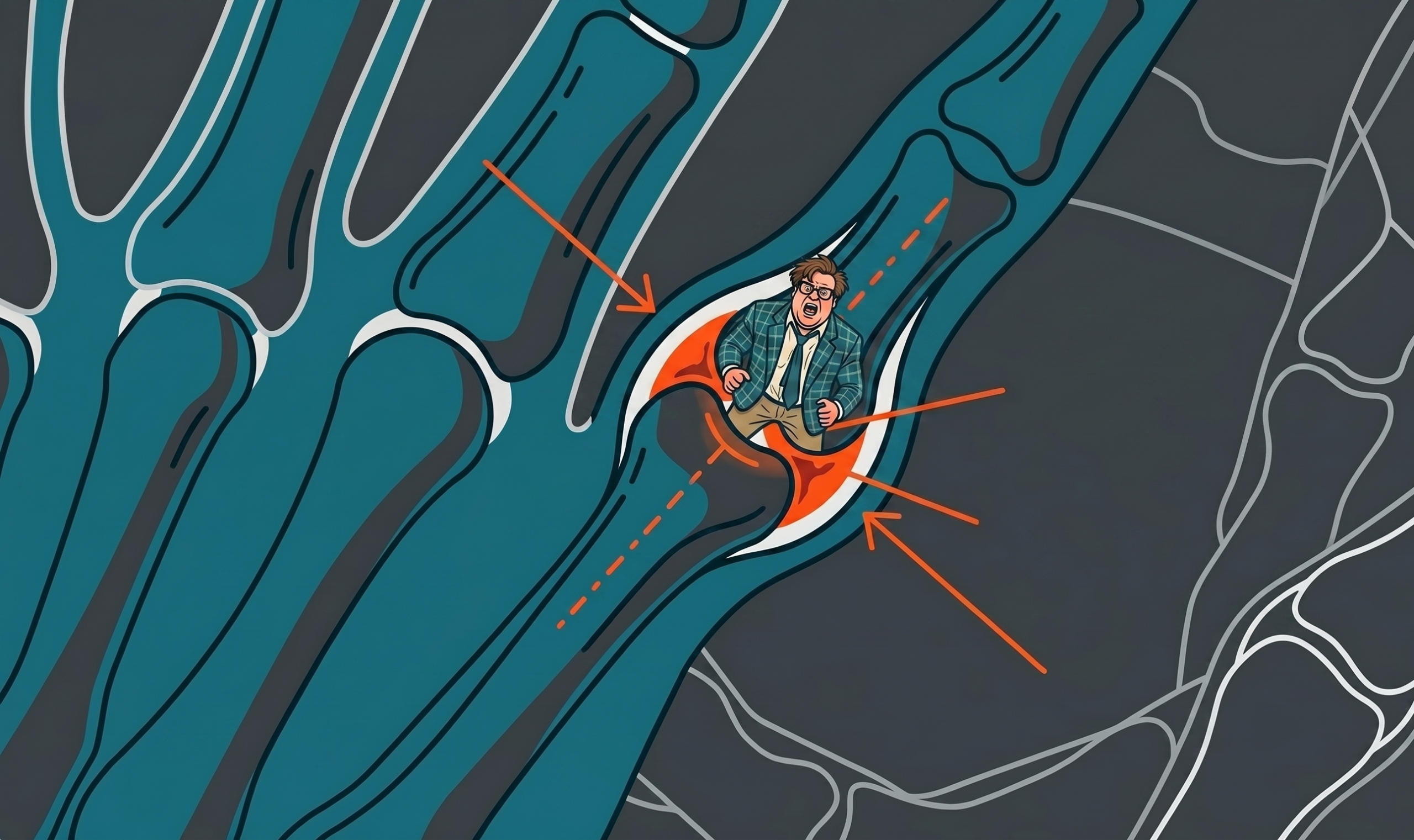
In small capacity joints, septic arthritis doesn’t stay contained—it bursts! Apropos, William Morrison, MD, of Thomas Jefferson University Hospital coined a very specific, Saturday Night Live-forward metaphor to help rads recognize the larger-than-life presentation of infection in tiny spaces.
The Chris Farley Finding: Just as the late physical comedy genius would don one-size-too-small outfits to accentuate his larger frame, septic arthritis in small joints creates an angry effusion that so often appears too big for its britches.
- The Mechanism: Because joints like the fingers, sternoclavicular, or sacroiliac (SI) have very small capacities, infection pops out of the capsule early on.
- The Look: Imaging reveals massive periarticular edema and enhancement disproportionate to the joint size.
Holy Schnikes! As Dr. Morrison described in MSK Infection Update: What Do I Need to Say and Do?, recognizing this bursting effect is critical for early diagnosis, especially in the sacroiliac joint.
- The Great Imitator: Septic sacroiliitis often presents as sciatica because the inflammation irritates the sciatic nerve sitting directly in the sciatic notch.
- The Diagnostic Trap: Clinicians may mistake the pain for a disc herniation and order a lumbar spine MRI.
- The Rad’s Role: Looking all the way to the edge of the image for SI joint edema, you may be the first to catch the infection.


Bottom Line: Beyond the Chris Farley finding, you’ll also want to watch for three more classic signs of septic arthritis in small joints:
- Erosions: Destruction of the joint surface.
- Loss of subchondral white line: A key indicator of joint space infection.
- Disproportionate soft-tissue involvement: Massive edema surrounding a tiny joint.
Leave a Reply