
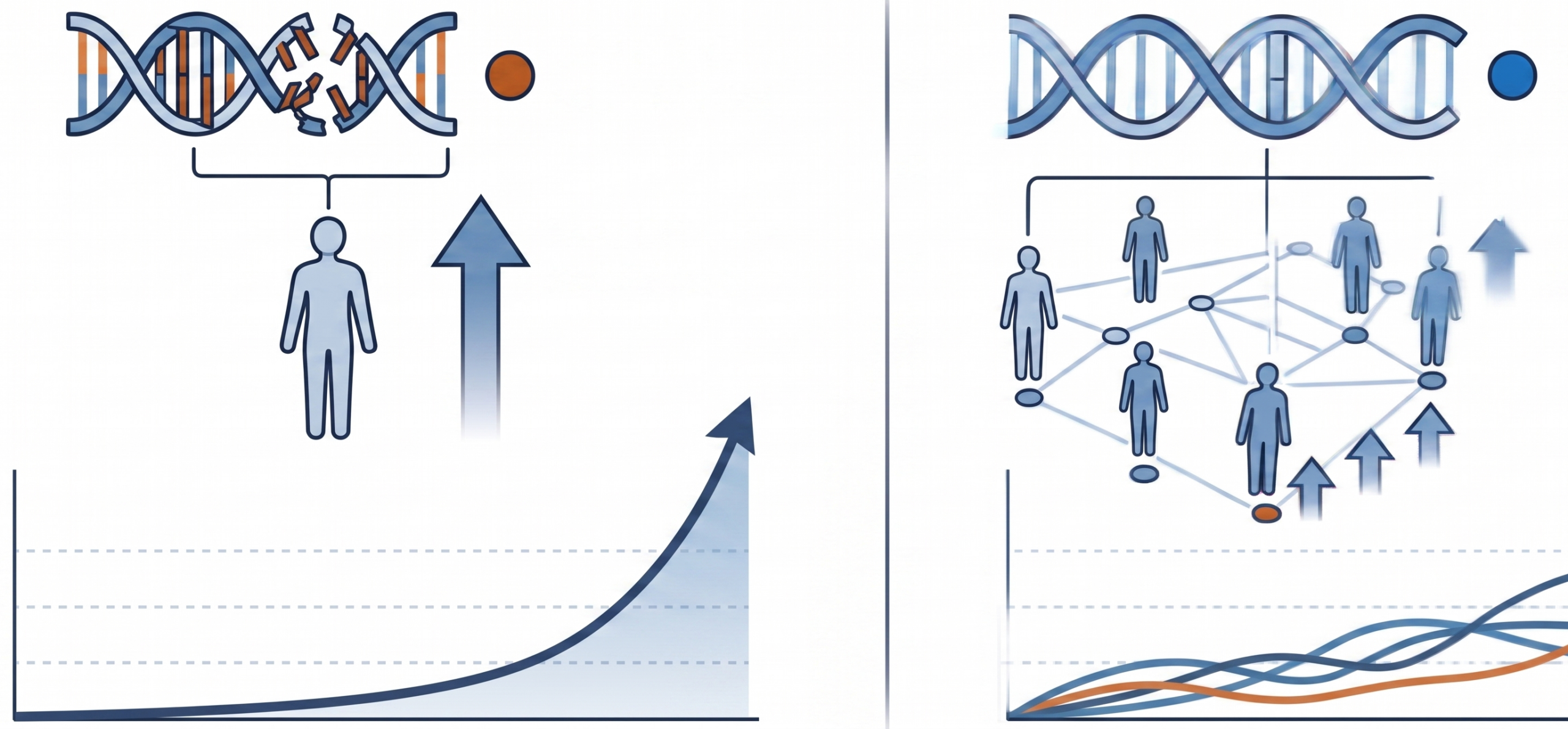
Tis a true distinction between rare, high-risk hereditary mutation and much more common genetic variation. And as MD Anderson Cancer Center’s Jessica Leung, MD, duly noted during the ARRS Online Course Essentials in Women’s Imaging, modern screening relies on comprehensive risk prediction models that move beyond single high-risk genes to evaluate a patient’s total risk profile, including single nucleotide polymorphisms (SNPs).
Palpable Risk—BRCA 1&2: The most well-known high-penetrance gene mutations, they follow Mendelian inheritance patterns (often appearing in every generation) and wield a high clinical significance for the individual.
- Profile: These mutations involve complex abnormalities like deletions or additions that create a very clear genetic risk from grandmother to mother to daughter.
- Limit: While high-risk, these mutations do not represent the majority of the population…or even the majority of breast cancer cases.
Sporadic Majority—SNP: Single-letter substitutions (e.g., an A for a T) in the genome, SNPs are fast and relatively inexpensive to sequence, often utilizing AI for detection.
- Profile: Individually, the single SNP provides a tiny additive risk.
- Impact: Meanwhile, when hundreds or thousands of SNPs are combined into polygenic risk scores, they become highly significant.
- Seems Likely: SNPs constitute the sporadic breast cancers that represent the overwhelming majority of cases seen in everyday life.
Beyond the Code: Truly effective risk assessment integrates more than mere DNA; rads must also evaluate the obvious: age, the biggest risk predictor, as well as modifiable factors like lifestyle and environment. Dense tissue creates a masking effect—comparable to a “polar bear in a snowstorm,” said Dr. Leung—making supplemental abbreviated MRI or CEM vital.
RadFYI: Whereas we’ve only just begun to grasp the full meaning of the hundreds of SNPs identified thus far, they’re key to understanding sporadic cancers that high-risk genetic testing all too often misses.
Leave a Reply