
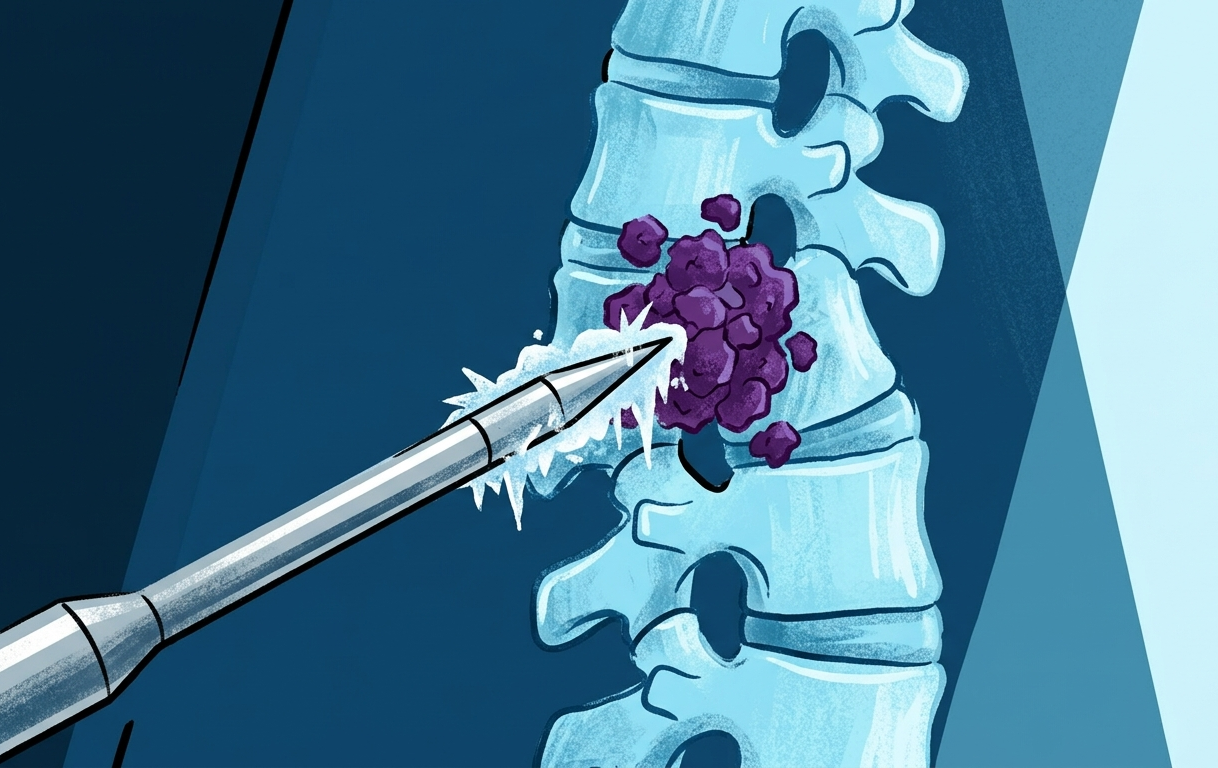
Cryoablation is becoming the hottest tool for managing complex osseous metastases, utilizing alternating cycles of rapid freezing and thawing to achieve reliable cell death. And as Anderanik Tomasian, MD, of UC Irvine explained during the ARRS Online Course Minimally Invasive Musculoskeletal Interventional Oncology Masterclass, cryoablation is uniquely suited for tumors where heat-based methods like radiofrequency ablation (RFA) often fail.
Why It Matters: Unlike RFA, which is ineffective for purely osteoblastic lesions due to high electrical impedance, cryoablation excels in treating these dense bone tumors. It also offers less intraprocedural pain and allows for the simultaneous use of multiple probes to cover large, complex geometries.
Freezing is Believing: The Ice Ball
- CT Visual: The primary advantage is your ability to see the hypoattenuating ice ball in real time.
- Precision on the Margins: The visible edge of the ice ball typically represents 0°C; to guarantee cell death (which requires –40°C), the ice ball must extend 3–5 mm beyond the tumor boundary.
- Heavy Caveat: While highly visible in soft tissue, the ice ball can be difficult to distinguish within the dense bone of a blastic lesion or normal bone.
Targeted Case: In Dr. Tomasian’s case of a patient with non-small cell lung cancer, cryoablation was successfully used to target a painful L4 osteoblastic lesion. Because RFA cannot effectively penetrate such dense lesions, cryoablation was the preferred modality for pain palliation and local tumor control.
Thermal Protection: Since bone cortex does not stop the expansion of an ice ball, adjacent vital structures are at risk.
- Active: Techniques like pneumodissection or even hydrodissection are used to displace and insulate nerves or the spinal cord.
- Passive: Strategies include placing thermocouples to monitor temperatures near sensitive structures, with active protection recommended if the temperature drops to 10°C.
Bottom Line: Cryoablation is a versatile, less painful, and highly visible intervention that provides a critical alternative for patients with refractory bone pain—particularly those with large soft-tissue components or blastic disease.
Leave a Reply