
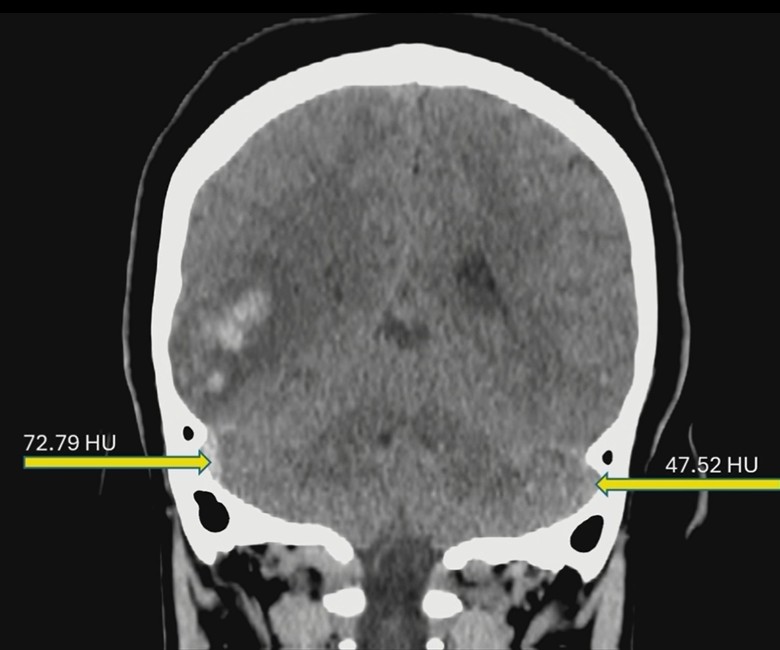
Sure, you’ll read a non-contrast head CT for headaches every day. But as Harprit S. Bedi, MD, reminded us during ARRS 2026, the rad’s real art lies in identifying dural venous sinus thrombosis (DVST)…before that CTA is even ordered.
DVST Dx: Symptoms of DVST can be insidious or acute, often presenting in high-risk patients (e.g., on oral contraceptives or experiencing pain worsened by valsalva). Since missing those subtleties can delay treatment for intracranial bleeds and venous congestion, look for these on that non-contrast CT:
- Hyperdensity: Typically, a thrombosed sinus measures >66 Hounsfield units (HU).
- 73 HU—The thrombosed sigmoid sinus in Bedi’s case above, compared to 47 HU in normal vessels.
- Three Signs:
- Triangle—Check for increased density in the dural sinuses.
- Cord—Look for hyperdense cortical veins.
- Empty Delta—Classic, if patient proceeds to a CTA.
- HU/Hematocrit Ratio: This tool can help differentiate true thrombosis from hemoconcentration, particularly in anemic patients.
RadFYI: Don’t just look for the bleed; look for the cause. If you see parenchymal changes or a hyperdense sinus on a non-con CT, use the HU tool to increase your confidence.
Leave a Reply