
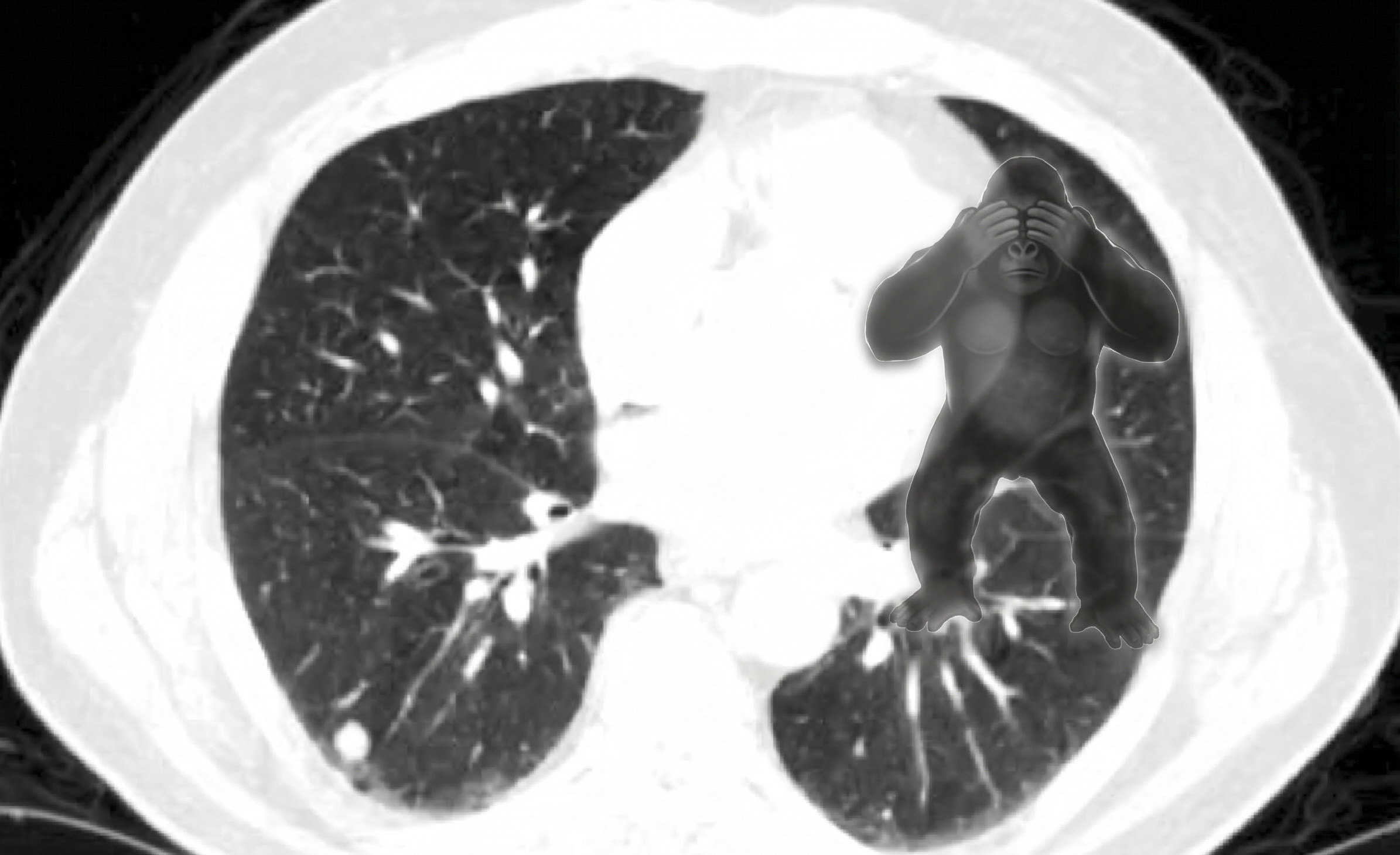
Summary: Alas, we cannot eliminate error through willpower alone. And mistakes tend to be repeated. To help prevent more harm, imagers can shift toward automated trigger tools, biases awareness, and department-level PQI.
Monkey Business: Blunders might just be this specialty’s specialty. According to Dr. Michael Bruno’s ARRS Web Lecture, our baseline blooper rate of 3–4% can surge to some 30% in abnormal cases. Most of the misses are not caused by a lack of imaging knowledge per se, but instead by fundamental quirks of perception.
We disagree with a colleague’s interpretation about 30% of the time, while disagreeing with our own prior readings 25% of the time. But because the lion’s share of lapses goes undetected in real time, we’re left with a false sense of accuracy—until that unexpected delay in diagnosis.
Gaffes by the Numbers:
- 80%: Percentage of rads who famously failed to notice the literal gorilla on a chest CT while actively searching for lung nodules.
- 40%: How much less likely a rad is to spot a second abnormality after finding the first one (the primary distraction mechanism historically termed “satisfaction of search”).
- 1 Year: Average delay before a missed radiological finding is finally recognized in clinical practice.
- 30%: Proportion of delayed-diagnosis errors that remain unrecognized, even on follow-up exams.
Fool Me Twice: Dr. Bruno specifically pointed to Kim and Mansfield’s landmark AJR study analyzing 1,279 radiological errors across 656 cases, where mistakes were categorized into a 12-step taxonomy:
- Continuing Medical Education: Again, lack of knowledge errors were extremely rare, proving that CME does bridge gaps.
- Doors of Perception: The vast majority of single-cause faux pas fell under underreading—simply failing to perceive what is all too often so blatantly obvious in hindsight.
- Attention, Please: Frequently, oversights occur when a lesion appears in an unexpected location or when an initial abnormality captures cognitive attention, distracting us from the secondary.
Leave a Reply