
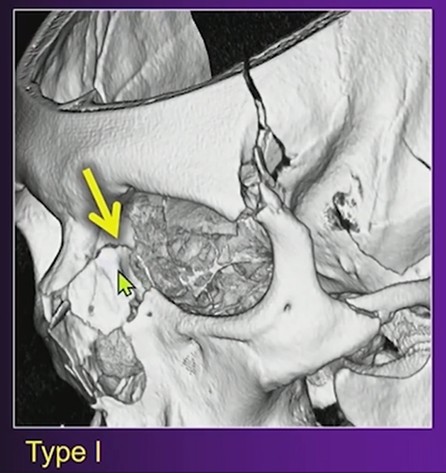
When evaluating orbital trauma, one detail rads should address is the Markowitz and Manson (M&M) classification. As Blair A. Winegar, MD, explains, this system focuses on the degree of comminution in the region of the lacrimal fossa and helps predict whether the medial canthal tendon is likely to be injured.
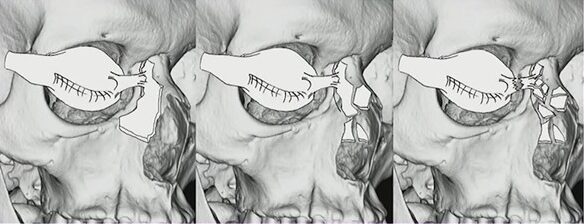
Left: Type I, Intact medial canthal tendon connected to single large fracture fragment; Center: Type II, Intact medial canthal tendon connected to single comminuted fracture fragment; Right: Type III, Disrupted medial canthal tendon with severe comminution about the lacrimal fossa
What M&M Describes
The key question is whether the lacrimal fossa remains intact or is significantly fragmented.
- Intact lacrimal fossa: Low likelihood of medial canthal tendon injury.
- Heavy comminution in the lacrimal fossa: Higher suspicion for medial canthal tendon disruption, which may require surgical repair.
Why Does It Matter?
The medial canthal tendon anchors at the anterior lacrimal crest. When that region is fractured extensively, the surgical team needs to prepare for possible tendon repair. Including this observation in your rad report sets appropriate expectations and guides planning for reconstruction.
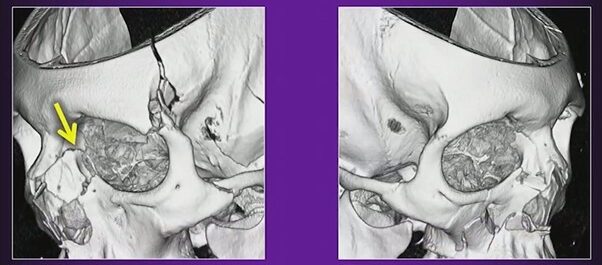
Left: Type I; Right: Type II
Practical Approach
On CT, evaluate the anterior lacrimal crest and adjacent lacrimal sac fossa.
Describe whether this region is intact, minimally displaced, or extensively comminuted. Explicitly link substantial comminution to the potential for medial canthal tendon involvement.
Bottom Line
In orbital trauma, reporting the Markowitz and Manson classification provides actionable information. Identifying comminution in the lacrimal fossa helps surgeons anticipate medial canthal tendon repair and improves communication between rads and the operative team.
Leave a Reply