
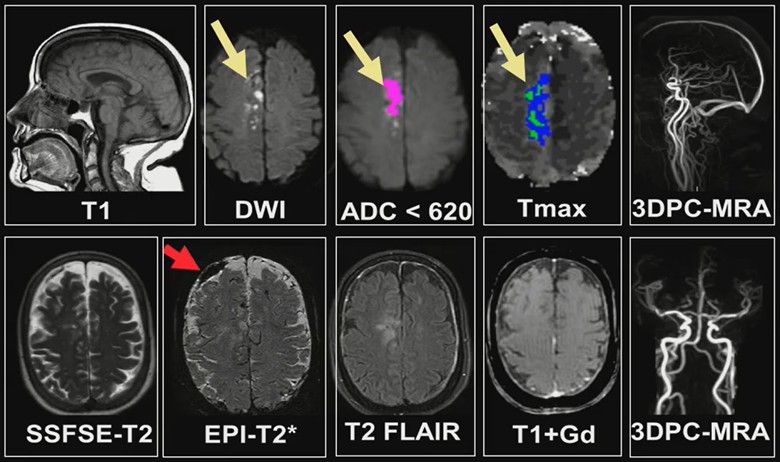
Summary: FAST’s future is in artificially deep reconstruction. Tech à la AIR Recon DL or Deep Resolve allows for even higher acceleration factors and noise reduction, perhaps slashing times further without sacrificing the quality required for ED triage.
Time Is Tissue: Trad MRI’s exam time too often limits its use in emergent settings. Focused Abbreviated Survey Techniques (FAST) protocols put time back on the clock. Fomenting rapid inclusion/exclusion of life-altering conditions, FAST helps make confident decisions sans the comprehensive scan’s half-hour wait.
- Stroke: Uses abbreviated sequences—with or without contrast—to detect acute ischemia and large-vessel occlusions.
- Spine: Screening tool for cord compression that can be completed in sub 20 minutes, versus 90 minutes for a total spine protocol.
- Peds: Motion-robust, non-sedated approach for monitoring shunted hydrocephalus or evaluating fluid-filled regions in ca. 4 minutes or less.
- EPIMix: Ultra-fast, 1-minute full-brain exam that provides multiple contrasts (T1, T2, FLAIR, DWI) simultaneously.
More Than Magnets: Success needs more than speed. As Dr. Laura B. Eisenmenger detailed in our Implementing FAST MRI Protocols Online Course, truly iterative implementation takes a dedicated kind of buy in:
- Clinicians must be on board with targeted exams, rather than comprehensive ones for specific indications.
- Utilizing dedicated ED scanners and radiology-specific transporters has been shown to significantly reduce order-to-first-image times.
- Staff turnover may mean yearly education to maintain efficient throughput and culture.


Leave a Reply