
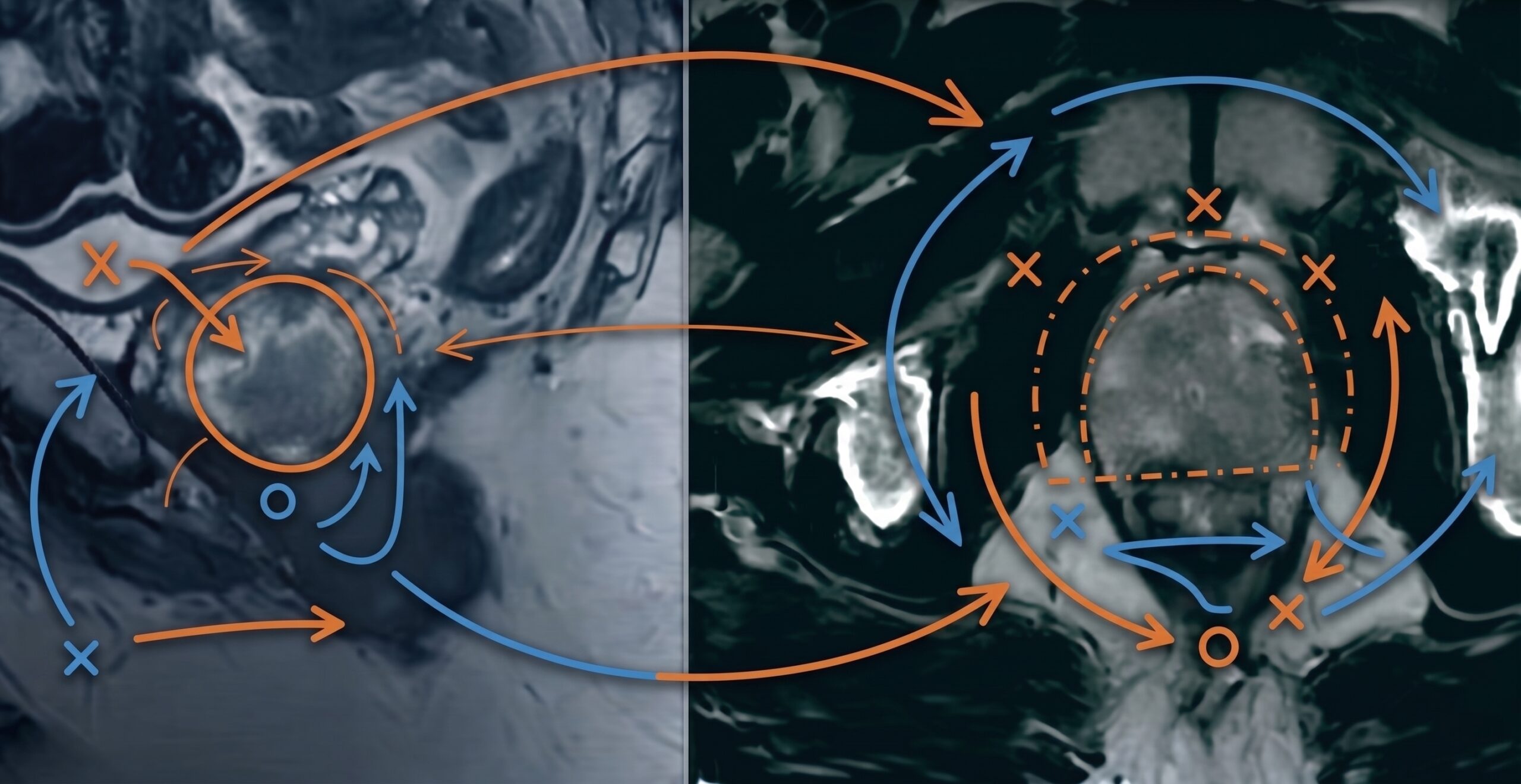
Summary: In the peripheral zone, DWI is king. If the diffusion is markedly restricted and the lesion is over 1.5 cm, indeed, it’s PI-RADS 5.
For clinically significant prostate cancer, understanding which sequences drive what scores is essential for accurate diagnosis and effective patient triage. In July’s session of our year-long Mastering Genitourinary Imaging & Interventions course, Dr. Nilda Maria Williams explained that PI-RADS v2.1 standardizes identification by utilizing specific “dominant” sequences based on the lesion’s anatomical location:
- Peripheral zone: Score is primarily driven by DWI.
- Transitional zone: Score is driven by T2W imaging.
- Limited DCE: Dynamic contrast enhancement plays a specific role—upgrading PI-RADS 3 to 4 in the peripheral zone.
5 on 5: Again, in the peripheral zone, a DWI score of 5 automatically results in a PI-RADS 5 assessment—regardless of T2W findings or enhancement. Criteria for this top-tier score include:
- Marked restriction: Lesion must be markedly hypointense on ADC and markedly hyperintense on high b-value DWI (i.e., darker and brighter than any other focus in that zone).
- Size threshold: Lesion must be >1.5 cm in its greatest dimension.
- Aggressive features: Evidence of definite extraprostatic extension also warrants a PI-RADS 5.
- T2W appearance: Typically, these lesions present as circumscribed, homogenous, moderately hypointense masses.
Leave a Reply