
Dementia with Lewy bodies (DLB) mimics Alzheimer’s disease, indeed. And as RadNet neuroradiologist Suzie Bash, MD, discussed during the ARRS Online Course “Opportunities and Obligations in Imaging Patients with Alzheimer’s Disease,” specific multimodal patterns—occipital lobe involvement, particularly—can help hone your DDX.
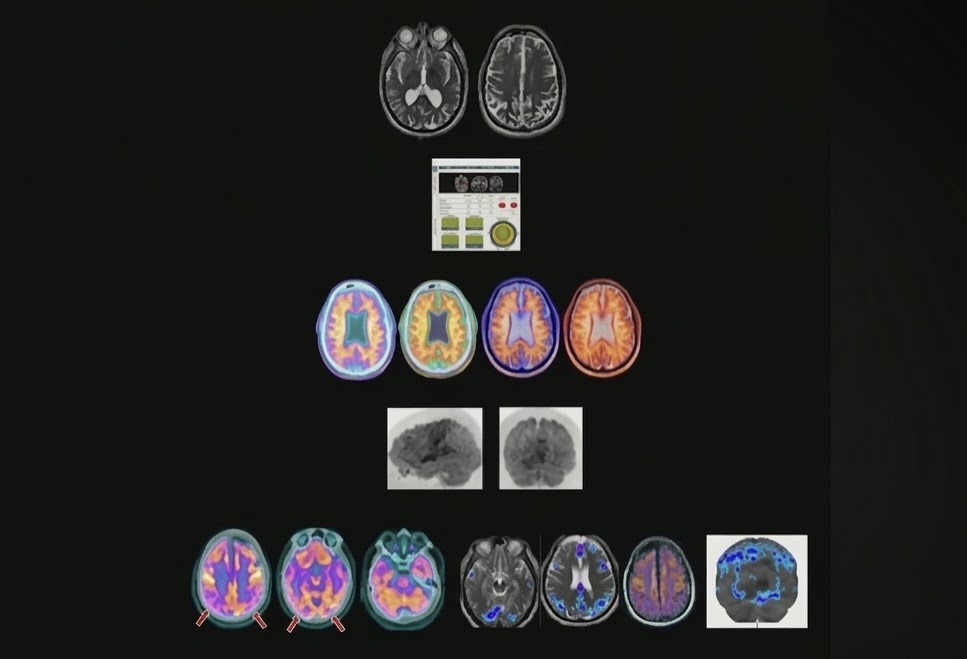
Big Pics: 73 y/o male presenting with visual hallucinations, resting tremors, and frequent falls (but only minimal memory loss) illustrates the clinical profile of classic DLB. Those bodies are defined by alpha-synuclein, sure, but imaging often reveals a much more mixed bag:
- MRI: Showed atrophy in the hippocampi, as well as occipital and parietal lobes.
- Amyloid PET: Positive, confirming beta-amyloid plaques can be present in DLB cases.
- Tau PET: Revealed deposition in posterior cingulate gyrus and occipital/parietal lobes.
- FDG PET: Confirmed hypometabolism in same posterior regions, a hallmark of the disease.
Bigger Numbers:
- 1 million: Americans living with DLB, compared to 6.7 million with Alzheimer’s.
- 80%: Frequency of visual hallucinations as a presenting symptom in DLB.
- 5–8 years: Typical survival rate following diagnosis.
Bottom Line: Rads should pay closer attention to the occipital lobe. Whereas Alzheimer’s and DLB share temporal and parietal overlaps, the addition of occipital atrophy and hypometabolism is a strong indicator of Lewy body pathology.
Leave a Reply