
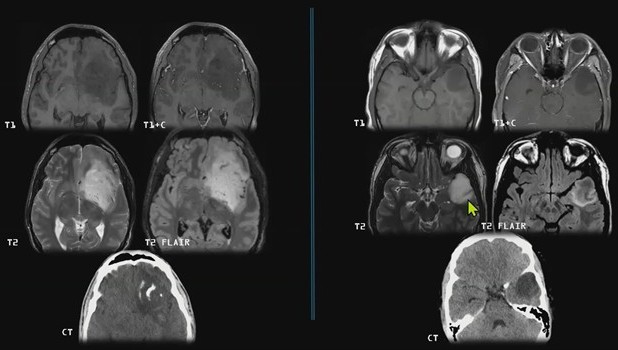
Distinguishing between oligodendroglioma and IDH-mutant astrocytoma is a high-yield challenge for neurorads, as both typically present as infiltrative, T2-hyperintense masses with variable enhancement.
1p/19q: While both tumors fall under the umbrella of IDH-mutant adult gliomas, their molecular signatures—and, consequently, imaging phenotypes—offer specific smoking guns for diagnosis.
- Oligodendroglioma: Defined by IDH mutation and 1p/19q codeletion.
- Astrocytoma: IDH-mutant but 1p/19q intact.
As part of the dynamic, rapid-fire Neuroradiology Case Review during the 2026 ARRS Annual Meeting, Susana Calle, MD, pointed out some key discriminators…
T2-FLAIR Mismatch: This is the strongest predictor for IDH-mutant astrocytoma, boasting a specificity of 90–100%.
- The lesion shows homogeneous high signal on T2-weighted images but complete or near-complete signal suppression on T2-FLAIR.
- The presence of this sign virtually rules out oligodendroglioma (although its absence does not exclude an astrocytoma diagnosis).
Worm-like: If you see gyroform cortical calcifications, think oligodendroglioma.
- Calcification occurs in up to 90% of oligodendrogliomas.
- These tumors have a strong frontal lobe predominance and tend to be more cortically based than astrocytomas.
- Astrocytomas are far less likely to calcify.
Perfusion Paradox: Typically, high cerebral blood volume (CBV) indicates high-grade malignancy, but oligodendrogliomas are the exception.
- Elevated CBV is often seen in oligodendrogliomas, regardless of grade, due to their characteristic “chicken-wire” fine intratumoral capillaries, rather than true neoangiogenesis.
Bottom Line: Calcified cortical tumor in the frontal lobe? Sway toward oligodendroglioma. T2-FLAIR mismatch sign identified? Think IDH-mutant astrocytoma. Accurate noninvasive identification of these genotypes is critical because 1p/19q codeletion in oligodendrogliomas is associated with a better response to chemoradiation and significantly improved overall survival.
Leave a Reply